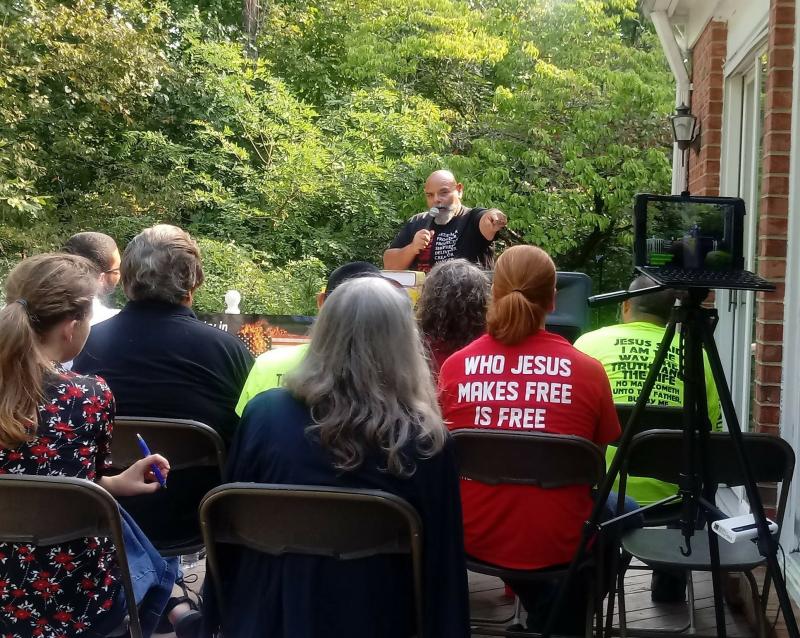
The pulpit God built first was outdoors. Jonah was sent to the streets of Nineveh; the prophets cried in the gates of Jerusalem; the Lord Jesus taught in the streets, on the hillsides, and from a boat; Paul reasoned in the market daily; and Whitefield drew thirty thousand at a time into open fields. This corner of the university belongs to that ministry: the charge of Scripture, the preaching itself, and the men of God who have done it.
Brethren in the same work, on their own YouTube channels — tap a name and watch them preach. (Channels verified live, October 2026.)
The Study: Abortion — What It Is and What It Does
A companion study of the Street Preachers Corner. On the sidewalk outside the clinic the argument is short, because it has to be: a mother is walking toward a door, and there are only moments to speak. But underneath the sidewalk stands a question that deserves its full answer, taken slowly, from the open Bible: what abortion is, and what it does. This study takes the question up in order — first, what Scripture says the child in the womb is; then, what God calls the taking of that child’s life; then, honestly, what abortion does — to the body, to the mind, and to the soul. And last, because this is a preacher’s study and not a prosecutor’s brief, it closes where the gospel closes every hard subject: with the mercy of God in Jesus Christ, held out to everyone who has had a part in this sin — mother, father, doctor, or silent bystander — and wants to be clean.
What the Child in the Womb Is
The Bible never speaks of the unborn child as a thing, a growth, or a part of the mother’s body. From its first page, Scripture speaks of every human life — born or unborn — as made, and made in a particular way:
“So God created man in his own image, in the image of God created he him; male and female created he them.” — Genesis 1:27 (KJV)
The image of God is not conferred at birth, like a name entered in a registry. It is God’s own workmanship, and the Psalms trace that workmanship back before birth — into the womb itself, where God is not watching a process from a distance but performing one with His own hands:
“For thou hast possessed my reins: thou hast covered me in my mother’s womb. I will praise thee; for I am fearfully and wonderfully made: marvellous are thy works; and that my soul knoweth right well. My substance was not hid from thee, when I was made in secret, and curiously wrought in the lowest parts of the earth. Thine eyes did see my substance, yet being unperfect; and in thy book all my members were written, which in continuance were fashioned, when as yet there was none of them.” — Psalm 139:13–16 (KJV)
David does not say that God foresaw what he would become. He says God saw him — “my substance, yet being unperfect” — and that his members were written in God’s book “when as yet there was none of them.” Before David had done anything, or been seen by anyone, he was a person in the knowledge and care of God. Nor is David an exception. God says the same of Jeremiah before his birth, Isaiah says the same of himself, and Job asks the question that settles the matter for every child, wanted or unwanted:
“Before I formed thee in the belly I knew thee; and before thou camest forth out of the womb I sanctified thee, and I ordained thee a prophet unto the nations.” — Jeremiah 1:5 (KJV)
“Listen, O isles, unto me; and hearken, ye people, from far; The LORD hath called me from the womb; from the bowels of my mother hath he made mention of my name.” — Isaiah 49:1 (KJV)
“Did not he that made me in the womb make him? and did not one fashion us in the womb?” — Job 31:15 (KJV)
The New Testament keeps the same witness, and gives it a heartbeat. When Mary, newly with child, came into Elizabeth’s house, the child in Elizabeth’s womb — John, six months unborn — answered the presence of the child in Mary’s womb:
“For, lo, as soon as the voice of thy salutation sounded in mine ears, the babe leaped in my womb for joy.” — Luke 1:44 (KJV)
Scripture calls John, unborn, a “babe” — the same word it uses for the babe laid in the manger (Luke 2:12). The Bible knows no second class of human life inside the womb. What is in the womb is a child: made in God’s image, formed by God’s hands, known to God by name. And that is what abortion ends — not “a pregnancy” in the abstract, but the life of a child. Plain speech matters here, because euphemism is the whole shelter of this practice: a “procedure” is performed on a “product of conception,” so that no one has to say the words child and killing in the same sentence. The preacher’s business is to say them — kindly, and without flinching — because no one ever repents of a euphemism.
What God Calls It
Because the unborn child is a person, the law of God treats harm done to that child as harm done to a person. When two men fighting struck a woman with child, the law of Moses did not wait until the child was born before it set the penalty:
“If men strive, and hurt a woman with child, so that her fruit depart from her, and yet no mischief follow: he shall be surely punished, according as the woman’s husband will lay upon him; and he shall pay as the judges determine. And if any mischief follow, then thou shalt give life for life, Eye for eye, tooth for tooth, hand for hand, foot for foot, Burning for burning, wound for wound, stripe for stripe.” — Exodus 21:22–25 (KJV)
Where mischief followed and a life was lost, the sentence was the sentence for a life: life for life, eye for eye, tooth for tooth. The unborn child stood inside the protection of the sixth commandment — Thou shalt not kill — long before any court on earth drew the same line. And God’s own list of the things He hates puts the matter past all softening:
“These six things doth the LORD hate: yea, seven are an abomination unto him: A proud look, a lying tongue, and hands that shed innocent blood,” — Proverbs 6:16–17 (KJV)
“Hands that shed innocent blood.” There is no blood more innocent than the blood of a child who has never done anything, to anyone, at all. Genesis grounds the seriousness of it in the same place this study began: a human life bears God’s image, and so to strike at that life is to strike at the One whose image it bears:
“Whoso sheddeth man’s blood, by man shall his blood be shed: for in the image of God made he man.” — Genesis 9:6 (KJV)
Abortion, then, in the Bible’s vocabulary, is the shedding of innocent blood: the deliberate taking of an unborn child’s life. The church does no one a kindness by calling it anything less — least of all the mother, who cannot be healed of a sin she is told she never committed.
What Abortion Does
Sin is never a private transaction, and this sin least of all. What abortion does can be traced on three fields, and a truthful study must walk all three.
On the body. First and plainest: a living child’s body is put to death — by the instruments of the clinic, or by drugs that cut off the womb’s support and expel the child. That is not rhetoric; it is simply what the procedure is, and it is why the photographs this Corner’s brethren carry on their signs change minds: they show the public the body. The mother’s body does not escape untouched either. Abortion is a violent interruption of a body doing the work God built it to do, and it carries the ordinary risks of surgery and strong drugs — bleeding, infection, injury to the womb — quite apart from everything else it does.
On the mind. Ask the sidewalk counselors what they meet, year after year: women — and men — carrying an abortion ten, twenty, forty years old, who think of it still. The world promises the mother relief, and many are handed grief instead: grief with nowhere to go, because the world will not grant that there is anything to grieve. The anniversary is remembered. The due date is remembered. The conscience God built into every soul (Romans 2:15) does not stop testifying because a culture stops listening. The mind goes on paying for this sin long after the clinic has been paid.
On the soul. Deepest of all: abortion is a debt before God. Blood that is shed cries out from the ground (Genesis 4:10), and a land that fills with innocent blood carries a guilt it cannot shrug off (Psalm 106:38). The person who has procured an abortion, performed one, paid for one, driven to one, or pressed for one stands before a holy God with blood on the account — and no court’s permission, no slogan about rights, and no passage of time washes an account like that. Only one thing in the universe does. Which is why this study does not end here.
Do not take a preacher’s word for what abortion does — hear it from a man who did it himself. Dr. Anthony Levatino performed some 1,200 abortions, over a hundred of them late-term, on children up to 24 weeks old, and in May 2013 he testified under oath before the United States Congress, describing in plain detail what he had done with the clamp, and why he could do it no longer:
Dr. Anthony Levatino, former abortionist, testifying before the Subcommittee on the Constitution and Civil Justice of the U.S. House Judiciary Committee — May 23, 2013.
The Charge Laid on God’s People
If this is what abortion is, then silence is not neutrality; it is abandonment. The Psalms lay a duty on everyone who knows:
“Defend the poor and fatherless: do justice to the afflicted and needy. Deliver the poor and needy: rid them out of the hand of the wicked.” — Psalm 82:3–4 (KJV)
The unborn child is the poorest and neediest neighbour any of us has: no voice, no advocate, no possibility of escape. To rid such a one out of the hand of the wicked takes the very forms this Corner exists for — preaching at the clinic door, counsel on the sidewalk, and a church ready to feed, house, and stand by a mother who chooses life, so that no woman is told her only help is a clinic. For children, God’s word insists, are not a burden to be managed but a heritage to be received:
“Lo, children are an heritage of the LORD: and the fruit of the womb is his reward.” — Psalm 127:3 (KJV)
A culture that has forgotten that sentence will do what ours does. The church’s work is to remember it out loud — in the churches, at the clinics, and in the culture — until the nation remembers it too.
The Door of Mercy
Now the word for the reader who has come this far with a weight on them. Everything above is true — and if it were the whole truth it would crush every one of us, for no one can read the sixth commandment with Jesus’ own interpretation of it (Matthew 5:21–22) and claim spotless hands. The gospel of Jesus Christ speaks to the guilty; that is the whole point of it. God invites the blood-stained to come and reason together with Him, and He names the colour of the sin and the colour of the cleansing in a single breath:
“Come now, and let us reason together, saith the LORD: though your sins be as scarlet, they shall be as white as snow; though they be red like crimson, they shall be as wool.” — Isaiah 1:18 (KJV)
David knew what it was to have innocent blood on his account — the blood of Uriah — and Psalm 51 is his prayer when the prophet finally brought the charge home. It is still the prayer of everyone who wants this sin, or any sin, washed away:
“Purge me with hyssop, and I shall be clean: wash me, and I shall be whiter than snow.” — Psalm 51:7 (KJV)
And the Lord Jesus — who had every right to be the sternest voice in this study — set the pattern for how the guilty are received when they come to Him. To a woman caught in sin, dragged before Him by her accusers with the stones already in their hands, He said:
“She said, No man, Lord. And Jesus said unto her, Neither do I condemn thee: go, and sin no more.” — John 8:11 (KJV)
No condemnation for the one who comes; no licence for the one who would go back: go, and sin no more. That is the whole gospel in one sentence, and it is spoken today to the mother who ended her child’s life, to the father who paid or kept silent, to the worker who assisted — to anyone who will come. The apostle John, writing to Christians, seals it with the very condition and the very promise:
“If we confess our sins, he is faithful and just to forgive us our sins, and to cleanse us from all unrighteousness.” — 1 John 1:9 (KJV)
If that is you: confess it to God — plainly, by name, without excuses — and believe the promise. The blood of Jesus Christ cleanses from all sin, and “all” was written for cases exactly like this one. Then find a church that preaches this Bible, and tell the pastor; you will not be the first soul carried through that door, and you will not carry it alone. And if you are the one standing on the sidewalk with this study in your heart: open thy mouth for the dumb, plead the cause of the child who cannot plead — and hold out, in the same breath, the mercy that is the reason any of us is standing there at all.
The Corner’s one category of full study courses for the preacher’s own grounding — the studies and the courses together, with no second category beside them: the history of the work he has taken up, the prayer life that powers it, and the Open-Air Preaching course standing with them below. Finish any of them, and its Character Certificate Card is dealt into your wallet.
The deep end of the training ground — the simulations built for the man who preaches in the open air. Answer the heckler out of the Scriptures, preach the verse from your heart with no page between you and the soul in front of you, and know a true witness from a stranger. This is training for the street, and it does not go easy on you.
Heckler Mode
A heckler in the crowd shouts an argument against the faith — and four verses stand before you. Only one of them is the verse that answers him. Strike back with that verse, against the clock: the crowd does not wait.
FIVE LEVELS — Babes · Novices · Ministers · Masters · Hey Moses
Enter ›
Preach the Verse
A reference is called, and nothing else — no text, no passage around it, no hints. Preach the verse from its reference alone, word for word, as if a soul on the street just asked you for it.
FIVE LEVELS — Babes · Novices · Ministers · Masters · Hey Moses
Enter ›
Two Witnesses
One reference is named, and two passages stand before you that almost sound the same. One is the true King James text; the other carries one small change — a word swapped, a number altered, a name exchanged. Tell the true witness from the near lie.
FIVE LEVELS — Babes · Novices · Ministers · Masters · Hey Moses
Enter ›
Greek Training Simulator
The words behind the Word: 217 Greek words of the New Testament. Study each band — meaning, definition, and the verse the word stands behind — then be drilled on it until every word in your set is mastered.
FIVE LEVELS — Babes · Novices · Ministers · Masters · Hey Moses
Enter ›
Sermon Building Simulator
The preacher’s workbench: a text is set, and you build its whole sermon — burden, proposition, introduction, points and the verse that carries each one, guarding the outline against intruder points, then illustration, application, and conclusion.
FIVE LEVELS — Babes · Novices · Ministers · Masters · Hey Moses
Enter ›
Vanishing Verses
“Thy word have I hid in mine heart, that I might not sin against thee.” The memorization simulator: a verse of Scripture stands before you with the clock beside it — then it vanishes, and you must speak it back from memory, graded word by word. A thousand of the most important verses in the Book; the level is the memorization clock, from ninety seconds down to fifteen.
FIVE LEVELS — Babes · Novices · Ministers · Masters · Hey Moses
Enter ›
Hide the Word in Your Heart
The memory module: the top five hundred verses of the Bible in fifty sets of ten — the verse is given to you, then it vanishes, and you speak it back into the microphone, verbatim, or it does not pass. Every set of ten mastered strikes its own Character Certificate Card.
FIFTY SETS OF TEN VERSES
Enter ›
Advanced Verse Memorization
The preacher’s armory, drilled deep: eighty-two street verses in five packs — the Gospel, Law & Conscience, Answering Objections, Judgment & the World to Come, and Grace, Assurance & Invitation — climbed rung by rung from reading to word-perfect recall, kept sharp by spaced review, and proven in street drills against the clock.
FIVE PACKS · SPACED REVIEW · STREET DRILLS
Enter ›
“Thy word have I hid in mine heart, that I might not sin against thee.” — Psalm 119:11. A preacher on the street has no concordance in his hand; the Word must be in his heart. Hide the Word in Your Heart stands under this heading with the simulation trainings, and its law stands as it was: a card for every set of ten verses mastered, spoken from the heart and judged word for word against the King James Bible.